🌫️ Humidity doesn't warn: it can ruin an entire shipment
Every year, thousands of companies lose money to an invisible enemy: humidity.
Mold, corrosion, or oxidation not only damage the product but also destroy your customers’ trust.
If you work in logistics, export, or industrial storage, you know the cost of a return, a customs rejection, or a failed audit due to humidity.
And the most frustrating part: many of these incidents could be avoided with a correct calculation of the desiccant.
🧠 Why calculate the desiccant accurately?
Each packaging has a different volume, exposure time, and environmental conditions.
Estimating “by eye” can be costly:
📦 Less desiccant than needed → condensation, mold, corrosion.
💸 More than needed → unnecessary expense and inefficient logistics.
The YDRY Desiccant Calculator applies the DIN 55473 standard, which defines the technical absorption equivalence (1 DIN unit = 6 g of water vapor at 23 °C / 40 % RH).
The calculation combines packaging volume, transit duration, and ambient humidity, to provide an exact recommendation in seconds.
⚙️ How the YDRY Calculator works
Enter the dimensions and type of packaging.
Average humidity of the route or warehouse.
Indicate the estimated duration of transport or storage.
Instantly receive the exact amount of recommended desiccant (in DIN Units and in equivalent grams).

🧪 What’s behind YDRY's accuracy
Our calculator is based on internal studies and international standards, integrating validated moisture transfer models with desiccants Silica Gel, Natural Clay, and Clay with Chloride..
| Type of desiccant | Absorption | Temperature range | Applications |
|---|---|---|---|
| Silica Gel | 25–30 % | -20 °C to 60 °C | General, mixed logistics |
| Natural Clay | 18–22 % | -20 °C to 50 °C | Economical, short term |
| Clay with Chloride | 30–35 % | -40 °C to 80 °C | High humidity, aggressive environments |
All YDRY desiccants comply:
✅ DIN 55473 – technical classification
✅ Regulation (EC) 1935/2004 – suitable for food contact
✅ Regulation (EU) 2017/625 – official control and traceability
✅ Labeling in accordance with CLP (Reg. 1272/2008)
✅Downloadable technical data sheets and free consulting.
📈 Real cases: precise control, no margin for error
🔹 Maritime export of sensitive electronic components
Route: Asia → Europe
Loading format: Consolidated pallet (1.8 m³) in shared 20’ maritime container (LCL)
Packaging type: Individual boxes in plastic film inside a corrugated cardboard master box
Expected environmental conditions: Average RH 75 % | Estimated transit: 45 days.
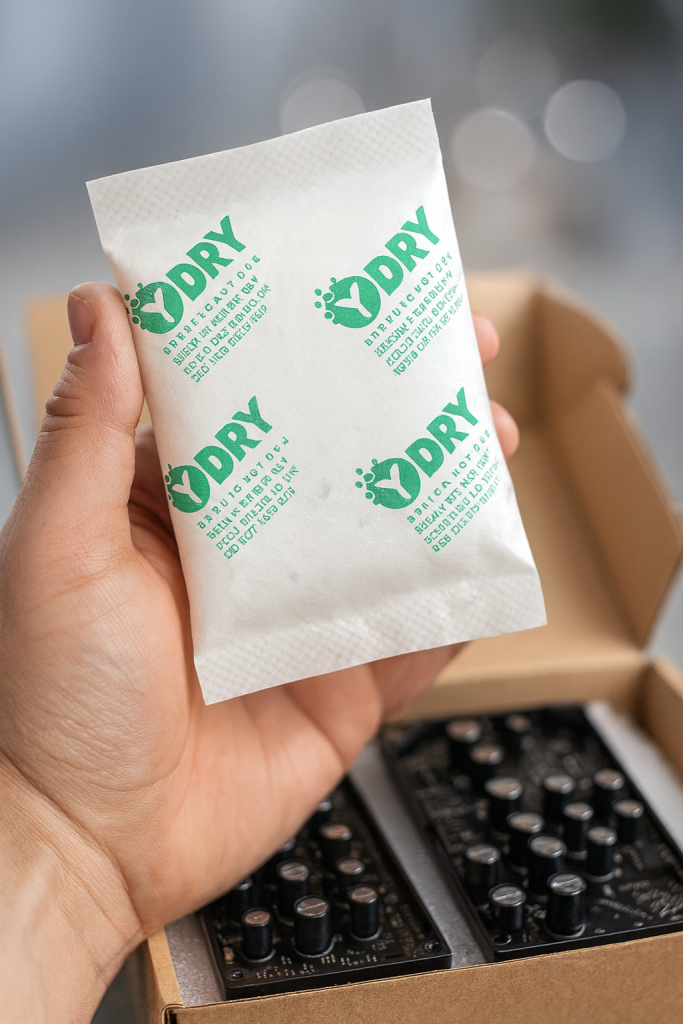
Technical solution applied:
36 units of desiccant YDRY SG 250 g (total 6 kg)
Desiccants placed directly inside the master boxes, in individual bags, without direct contact with the components
Application validated with DIN 55473 loading formula, adjusted for closed volume and average transit RH
Result obtained:
✅ 0 % corrosion detected upon receipt
✅ 0 claims at destination
✅ Electronic quality intact
👉 Key case to demonstrate effectiveness in sensitive loads in LCL logistics
🔹 Prolonged pharmaceutical storage in tropical climate
Location: Distribution center in Mexico
Storage format: Unclimatized warehouse on racks
Product: Thermostable tablet blisters in cardboard boxes
Environmental conditions: Average RH 80 % | Temperature 35 °C | Duration: 90 days
Technical solution applied:
20 units of activated alumina 250 g (placed inside the master boxes, without direct contact with the drug)
Desiccant chosen for its thermal stability and compliance with European and Mexican regulations on indirect contact with medicines
Granular structure that maintains constant adsorption capacity under tropical conditions
Result obtained:
✅ Reduction of internal RH to 38 % (safe stability condition)
✅ Integrity of the active ingredient preserved
✅ Compatible with food and pharmaceutical regulations
Frequently asked questions
Yes. The calculator estimates DIN units based on total volume and expected humidity.
The dew point is reached sooner → condensation → irreversible damage.
Yes, silica gel and activated alumina are regenerated in an oven between 120–200 °C.
Yes. Our models with PEM-HI® food-grade wrapping comply with current European and Spanish regulations.
Take the next step: calculate your ideal protection
Avoid losses, delays, and claims with a tool designed by technicians for technicians.
In less than a minute, you will know what type and amount of desiccant you need.
🔗 Calculate now →
📩 Or request a free technical consultation: our experts will help you size the exact solution for your product.