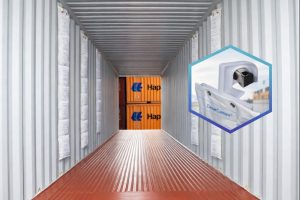
The container rain is the condensation that forms on the roof and walls of a shipping container during the voyage and drips onto the goods. It is the most common cause of wet boxes, mold, rust and peeling labels in export, and it is almost never covered by insurance, because it is considered a failure in cargo preparation.
Why container rain forms
A closed container is a metal box with air and goods inside. During the day, the sun heats the roof and the inside air, which can then hold more water vapor; that vapor comes from the cargo itself, the wooden pallets and the cardboard. At night, the roof and walls cool below the dew point and the vapor condenses into droplets that fall onto the cargo. The cycle repeats every day of the voyage.
- Moisture in the cargo and packaging: wood, pallets, cardboard, paper, coffee, cocoa, cereals or textiles release water during the voyage.
- Climate changes: moving from warm to cold areas (or vice versa) multiplies condensation cycles.
- Humid air at loading: loading in the rain or in very humid ports brings in water from day one.
Container rain and cargo sweat: not the same thing
| Container rain (container sweat) | Sudor de la carga (cargo sweat) | |
|---|---|---|
| Where it condenses | On the roof and walls of the container | On the goods themselves |
| When it happens | When the container cools down (at night, cold areas) | When cold cargo arrives in a warm, humid climate |
| How to prevent it | Reducing air humidity with desiccants and dry cargo | Avoiding opening the container while warm and protecting the product inside the boxes |
Damage it causes
- Softened cardboard and crushed boxes.
- Mold and bad odors in food, textiles, footwear and furniture.
- Rust and corrosion on metal parts and machinery (more information in how to prevent corrosion in automotive parts).
- Peeling labels and product rejected at destination.
- Customer claims that insurance does not usually cover.
How to prevent container rain
- Dry cargo and pallets: avoid damp wood and exposed cardboard; do not load in the rain.
- Check the container: dry floor, no holes or traces of water. We explain it step by step in how a container is prepared.
- Hang Container desiccants on the walls, spread along the container. For long transits, clay + calcium chloride ones, such as the Cargo 1000, have the highest capacity.
- Protect the product inside the boxes with silica gel sachets if the goods are sensitive.
- Calculate the quantity: as a reference, 1 box of Cargo Pack for 20 ft and 2 for 40 ft; fine-tune it with this guide or with the desiccant calculator.
Do you export often? Tell us your route and your cargo and we will recommend the exact protection for your container.
Frequently asked questions
Does insurance cover container rain?
Usually not. Insurers tend to consider it damage due to insufficient preparation or packaging, not a transport incident. That is why it pays to prevent it.
Do the container’s ventilation holes help?
Only a little: standard containers have hardly any ventilation and the outside air at sea is also humid. Effective protection means reducing the moisture inside with desiccants.
How long do container desiccants protect?
Clay + calcium chloride ones are designed for transits of several weeks; their capacity depends on the model and the moisture of the cargo. Size them according to the length of the voyage.