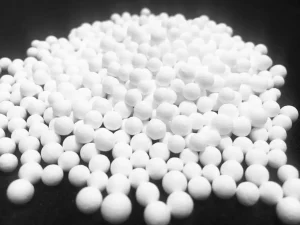
Adsorption compressed air dryers use a desiccant to retain moisture from the air. In most units that desiccant is activated alumina, but when the process needs extremely dry air, alumina is not enough and molecular sievecomes into play. In this article we explain when it is needed, which type to choose and how to know when it needs replacing.
What dew point do you need
ISO 8573-1 classifies compressed air quality according to its pressure dew point. That figure decides the desiccant:
| ISO 8573-1 class (humidity) | Pressure dew point | Usual desiccant |
|---|---|---|
| Class 3 | −20 °C | Activated alumina (or refrigerated dryer) |
| Class 2 | −40 °C | Activated alumina |
| Class 1 | −70 °C | Molecular sieve, or alumina + a sieve layer |
Down to −40 °C activated alumina is the most economical option; we explain it in activated alumina for compressed air dryers. Below that figure (air for electronics, pharma, instrumentation, high-quality painting or outdoor equipment exposed to frost) molecular sieve is needed.
Why molecular sieve goes further
- It holds water much more strongly than alumina, so it keeps adsorbing when the air is already almost dry.
- It keeps its capacity at higher temperatures, which is common at a compressor outlet in summer.
- It also removes CO₂ (type 13X), which is needed in air for gas separation or for some chemical processes.
Which type of sieve to use: 13X or 4A
| Type | When to use it | YDRY format |
|---|---|---|
| 13X | The most used in dryers: maximum capacity and removes moisture and CO₂ at the same time | 13X 3-5 mm, 13X 4-6 mm, 13X pellets 1/8″ |
| 4A | General drying when CO₂ does not need to be retained | 4A 3-5 mm |
Many dryers combine both desiccants: a lower layer of activated alumina, which retains most of the water and protects the bed from droplets and oil, and an upper layer of molecular sieve for fine drying. This extends the life of the sieve and lowers the cost of the fill.
Which particle size to choose
- 3-5 mm: the standard format for medium-sized heatless (PSA) and heated (TSA) dryers.
- 4-6 mm or pellets: large beds and high flow rates, where reducing pressure drop matters.
- 1-3 mm: compact dryers and small columns, with very short cycles.
If you are refilling an existing dryer, follow the particle size specified by the manufacturer: changing it alters the pressure drop and the regeneration cycle.
When to replace the sieve
- The outlet dew point rises and does not recover after several cycles.
- Dust appears in the downstream filters: the beads are breaking.
- Oil or liquid water has entered the bed (failure of the separator or prefilter).
- As a reference, many manufacturers recommend checking it every 3-5 years.
To refill, remove all the old desiccant, clean the towers and fill with dry, freshly opened product: the sieve starts adsorbing moisture as soon as the bag is opened.
Do you service or manufacture compressed air dryers? We supply molecular sieve in 20 and 25 kg bags from Spain, with technical data sheet and volume pricing for pallet orders. Request a quote or see all formats in the molecular sieve shop.
Calculate your dryer’s load
Instant result, no sign-up or email. · See the full calculator and how we calculate
Frequently asked questions
Can I mix molecular sieve with the alumina I already have?
Yes, but in layers, not mixed: alumina at the bottom, where the wet air enters, and sieve on top. Mixed together, you lose the benefit of protecting the sieve.
How much molecular sieve does a dryer need?
It depends on the flow rate, pressure, inlet temperature and cycle. The fill quantity is in the dryer manual; if you do not have it, send us the model and we will help you.
Does molecular sieve work in heatless dryers?
Yes. In heatless (PSA) dryers the sieve is regenerated with a purge of dry, low-pressure air, without heating, in cycles of a few minutes.