Compressed air leaves the compressor loaded with moisture. If it reaches the installation like that, it causes corrosion in pipes, failures in valves and cylinders, and defects in processes such as painting or packaging. When very dry air is needed, an adsorption dryeris installed, and the material that does the work is usually activated alumina.
How an adsorption dryer works
Most adsorption dryers have two towers filled with desiccant that work in turns:
- While one tower dries the air passing through it, the other is regenerated, expelling the accumulated moisture.
- In heatless dryers, regeneration uses part of the dry air itself.
- In In heated (heated or blower) dryers, a heater or blower is used to regenerate with less air consumption.
This way the dryer works continuously and the desiccant lasts many cycles.
Why activated alumina
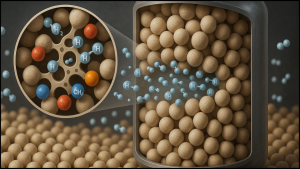
The activated alumina is a porous aluminum oxide in bead form. It is the most common desiccant in compressed air dryers because:
- It has good adsorption capacity for water.
- It is mechanically very strong: it withstands the pressure changes of thousands of cycles without breaking into dust.
- It regenerates well with both dry air and heat.
- It tolerates the occasional presence of liquid water better than other desiccants.
Activated alumina or molecular sieve
| Activated alumina | Molecular sieve | |
|---|---|---|
| Typical use | Standard compressed air drying | When extremely dry air is needed |
| Dew point | Usually around -40 °C | Can go down to -70 °C or lower |
| Strength | Very high | High |
| Cost | Lower | Higher |
Many dryers combine them: a layer of activated alumina at the inlet, which handles high humidity better, and a layer of molecular sieve at the end to reach the lowest dew point. The configuration is defined by the dryer manufacturer. If you need to reach −70 °C, we explain it in molecular sieve for compressed air dryers.
When to replace the alumina
- When the dew point rises steadily even though the dryer is working correctly.
- If white dust appears in filters or in the air line: it means the beads are wearing out.
- If oil has entered the towers due to a prefilter failure: oil blocks the pores and the alumina loses capacity.
- Following the manufacturer’s maintenance plan, which usually specifies replacement by service hours.
Maintenance tips
- Look after the prefilters (coalescing): they protect the alumina from oil.
- When replacing it, change the load in both towers at the same time so they work in balance.
- Use the particle size specified by the dryer manufacturer; the most common is 4-6 mm activated alumina. If you do not know it, send us the model.
- Store spare alumina in its closed packaging: it absorbs ambient moisture if left open.
Need to replace the alumina in your dryer? Write to us or request a quote in the form and we will advise you with no obligation.
We supply bulk activated alumina and help you identify the right format for your equipment.
Calculate your dryer’s load
Instant result, no sign-up or email. · See the full calculator and how we calculate
Frequently asked questions
How often is the activated alumina in a dryer replaced?
It depends on operating hours, inlet air quality and the manufacturer. The real indicator is the dew point: when it rises steadily, it is time to check.
Can activated alumina be reused?
Inside the dryer it is regenerated continuously. Once it is removed due to wear or oil contamination, reusing it is no longer recommended.
Active or activated alumina?
It is the same product. The correct technical name is activated alumina.