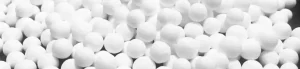
The silica gel (or silica gel) is the most widely used desiccant to protect products from moisture. It is those translucent beads you find in a sachet inside a box of sneakers, an electronic device or a medicine bottle. In this guide we explain what it is, how much moisture it absorbs, what types there are and how to choose the right one.
Need silica gel for your business?
Silica gel sachets from 0.5 to 500 g, strips for containers and bulk silica, white or orange indicating. We recommend the format and quantity for your packaging.
See silica gel for businessesContents
– What silica gel is
– Properties of silica gel
– How much moisture does silica gel absorb?
– Types of silica gel
– What is silica gel used for?
– How silica gel is used
– Which industries use silica gel
– Why silica gel is so effective
– Silica gel standards and certificates
– Common mistakes when using silica gel
– How to choose the right silica gel
What silica gel is
Silica gel is amorphous silicon dioxide (SiO₂) made synthetically from sodium silicate. It comes as translucent granules or beads with a very porous internal structure: although they look solid, inside they are full of microscopic pores that adsorb water molecules from the air and retain them.
That moisture stays trapped inside the granule: silica gel does not get wet, drip or dissolve, even when saturated.
Properties of silica gel
- High adsorption capacity: retains a significant amount of water in its porous structure.
- It depends on conditions: its capacity varies with relative humidity and temperature; it decreases at high temperatures, although it remains effective in most ambient conditions.
- Chemically inert: it is not corrosive and does not react with the product it protects, which is why it is used in food and pharma with the right packaging.
- Granular: it distributes evenly in sachets, packs and containers.
How much moisture does silica gel absorb?
It depends on the relative humidity of the environment: the more humid, the more water it retains. As a reference, according to the technical data sheet of our PEM-HI sachets, silica gel adsorbs at least 19% of its weight at 40% relative humidity and 27% at 80% (at 25 °C, USP <670> method).
That is why “adding a sachet” is not enough: the quantity must be calculated according to volume, humidity and protection time. You can do it with our desiccant calculator.
Types of silica gel
- White silica gel: non-indicating. It is the most common in sachets for packaging, food and pharma.
- Orange indicating silica gel: changes color when saturated, so you can see when it needs replacing or regenerating. It is cobalt-free.
- Blue silica gel: uses cobalt chloride as the indicator. That is why orange is preferred today, and it is the one we work with at YDRY.
It is also made in different bead sizes. The smaller the bead, the faster it absorbs moisture: 1-3 mm silica acts sooner than 3-5 mm.
What is silica gel used for?
Silica gel is used to absorb and control moisture in enclosed spaces, so that the product does not suffer caking, mold, corrosion or loss of properties. Its job is not to “dry everything at once”, but to keep a stable humidity level during storage or transport. Its most common uses are:
- Protection in packaging: inside boxes and packs of electronics, clothing, footwear or documents.
- Preserving food and medicines: keeps products dry and extends their shelf life.
- Long-term storage: protects goods for months in a warehouse.
- Ocean freight: in strips for containers, it prevents condensation or container rain.
- Laboratories and museums: maintains controlled humidity conditions for samples and valuable pieces.
How silica gel is used
- In sachets: inside boxes, bags or packs. It is the most common format.
- In bulk or in large containers: for large-scale storage or to fill equipment.
- In strips for containers: they hang on the container walls.
- Reuse: indicating silica gel changes color when saturated and can be reused after proper drying.
Important: the space must be closed or almost closed. In an open space silica keeps absorbing ambient moisture and saturates quickly.
Which industries use silica gel
- Food (in direct contact, with special sachets)
- Pharma and medical equipment
- Textiles, leather and footwear
- Electronics and technology
- Chemical industry
- Optical instruments and photographic equipment
- Horticulture: drying plants, flowers and seeds
- Export and ocean freight
Why silica gel is so effective
Silica gel adsorbs water through polarity and molecular attraction, not by dissolving. Its huge internal surface lets it retain a lot of moisture in a small volume, and unlike other more aggressive desiccants it does not release liquids or break down, which makes it safe and controllable when the quantity is properly calculated.
Silica gel standards and certificates
- DIN 55473: defines the absorption units of technical desiccants.
- Regulation (EC) 1935/2004: materials suitable for food contact.
- FDA DMF: pharmaceutical use.
- REACH and CLP: European chemical compliance.
- Cobalt-free and DMF-free.
You can see the technical data sheets and safety data sheets for each format on our page for silica gel for businesses.
Common mistakes when using silica gel
- Using less than needed.
- Not calculating according to volume and relative humidity.
- Choosing the wrong packaging for the product (for example, for food or pharma).
- Leaving the pack open or poorly sealed.
- Not replacing the desiccant when it is saturated.
How to choose the right silica gel
| Criterion | Recommendation |
|---|---|
| Pack volume | Calculate the DIN 55473 units needed (desiccant calculator) |
| Duration of storage or voyage | More time = more quantity |
| Ambient conditions | Average relative humidity and temperature |
| Type of product | Food, pharmaceutical or technical: determines the packaging (PEM-HI or Tyvek®) |
| Visual check | Orange indicating silica gel |
| Temperature and budget | For general packaging at room temperature, also consider Clay |
At YDRY we advise you to define the right type and quantity of silica gel for your product. See all formats in silica gel for businesses.